Monday, October 12, 2015

Archaeological Discoveries in the Mortuary Temple of King Amenhotep III

The Egyptian-European expedition discovered a huge statue of King Amenhotep III (1390-1352 BC), who was the father of the first monotheist king, Akhenaton, and grandfather of the Golden King Tutankhamun. These discoveries have been made in the middle of archaeological excavations in the mortuary temple of King Amenhotep III in Kom al Haytan in Luxor’s West Bank. The statue is carved with alabaster and shows the king sitting, wearing a royal headdress, the “nams”, and with the beard properly decorated.

King Amenhotep III (1390-1352 BC)


It is believed that this statue is one of two statues that were located at the entrance of the third edifice of the Amenhotep’s temple, which is located 200 meters away from the Colossi of Memnon. These two statues were thought to have been crushed during the massive earthquake that hit the country in the Roman era, and which ruined all the temples and structures with the exception of the Colossus of Memnon.


Colossi of Memnon (Luxor Sightseeing)


The expedition also found the head of an idol 28.5 cm in length; this head depicts an idol wearing a wig which is part of the beard which has been found and that is in good condition. A text of 25 lines written in hieroglyphic letters that lists the name and the number of temples built by Amenhotep III has also been discovered. The plate is 7.40 m x 9 m.

Abu Simbel Temple


Copyright © Egypt, Cradle of Civilization


Abu Simbel is a massive monument standing proudly since the 13th century B.C. in Upper Egypt, 250 kilometers (or 155.343 miles) southeast of Aswan. The second most popular tourist attraction in Egypt after the pyramids is Abu Simbel. The Abu Simbel Temples are a UNESCO recognized site and part of the larger Nubian Monuments. The Temples are two separate temples next to each other carved in red stone.


Abu Simbel Temples built by Ramesses II in Nubia


These gigantic Abu Simbel Temples had to be relocated during the construction of the Aswan High Dam, otherwise they would be buried under the waters of Lake Nasser. The temples now overlook the lake on the western banks and are a must see when visiting Aswan city.


City of Aswan


It was built by Rameses II between 1279 and 1213 B.C. to celebrate his domination of Nubia, and his piety to the gods, principally Amun-Ra, Ra-Horakhty and Ptah, as well as his own deification Abu Simbel, much has been said about the purpose of building, like that they were built for Pharaoh Ramesses II and his beloved wife Nefertari.

It was also known as the "Temple of Ramesses, beloved by Amun", one of six rock temples erected in Nubia during the long reign of Rameses. What has been confirmed by most historians is that it is not debatable that a major reason for its building was to impress Egypt's southern neighbors, and to reinforce the status of Egyptian religion in the region.


 Ramesses II of Egypt (c. 1270 BCE)


The interior of the temple is inside the sandstone cliff in the form of a man-made cave cut out of the rock. It consists of a series of halls and rooms extending back a total of 185 feet from the entrance.


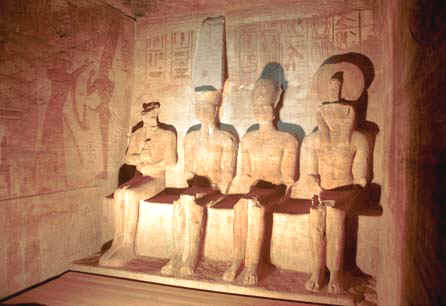
Abu Simbel Temple, Gods' statues


As you walk to the rear of the temple you come to the Holy of Holies located at the back wall, where you will find four statues of Ra-Harakhte, Ptah, Amun-Ra and King Ramses II.


Holiest of the Holies from inside Abu Simbel Temple


The Abu Simbel Festival

The Abu Simbel Temple is second only to the Pyramids in Giza necropolis, and the Abu Simbel Festival is second to none. At sunrise on both days February 21, the king's birthday, and October 22, the date of his coronation, the light creeps into the inner sanctum and shines upon all the statues essentially marking them as god-like. The statue of the god of darkness, Ptah, is appropriately left in the shadows. How this was managed have remained a wonder and a mystery up to now, people in Egypt still celebrate on those dates.


Touring Egypt at this time of the year can make your vacation more special having the privilege of witnessing such a mystical historic biannual event.


The Virgin Mary Tree

Copyright © Egypt, Cradle of Civilization

In the incoherent district of El-Mataria, in Cairo, there stands an old sycamore tree that has been attracting thousands of pilgrims each Christmas, it's called the "Virgin's Tree". There are many sacred trees in Egypt, trees that have offered shelter for the Holy Family during their stay here, but the one in Mataria holds the highest regard of all.

The Virgin's Tree at Al Matariyah
Mataria is now a heavily populated suburb in Cairo accessed by a modern fly-over, but 2000 years ago it was a fertile, simple village where many of these balsamic trees were grown and many date palms too. The village of Mataria was popular among pilgrims from the Holy Land and at the time it was considered one of the holy sites and a blessed place like paradise. Of all the sites visited by pilgrims after Christianity was declared the religion of the Roman Empire at the beginning of the fourth century, this tree was regarded as the most holy.

The Holy Family On Their Journey Into Egypt
The journey of the Holy Family took them from Palestine to Egypt, a journey that lasted for about three and a half years, taking them through many towns in Upper and Lower Egypt. The accounts of this journey are chronicled in a Mimar (manuscript) by Pope Theophilus, 23rd Patriarch of Alexandria (384-412 A.D.) He wrote down what the Virgin Mary told him when she appeared to him in a vision. Other sources of information include accounts by 2nd and 3rd century Greek and Jewish writers, philosophers and historians.


The Holy Family journeyed south from Palestine across the wilderness, avoiding the main road for fear of capture. They entered Egypt at modern-day Rafah, where a lone sycamore tree is said to have survived since their visit there too. The only other country where Jesus Christ is said to have lived besides his homeland Palestine, is Egypt. The reason apart from it being a land of plenty with no shortage of natural resources, Egypt was traditionally seen to have a high level of cultural integration and religious tolerance.


The holy journey of the holy family in Egypt
Today the balsam shrubs have long since disappeared and the sycamore that stands now grew from a shoot planted in place of the original tree but the tradition of the tree continues to live on. The sycamore was sacred in Pharaonic times and it was called "Nehet". The sycamore tree lives long and bears sun exposure and humidity. Ancient Egyptians used them in making wooden monuments. Sycamores exist all over the Delta, Upper Egypt and also in the oases. It is considered a popular fruit in villages. These trees are beautiful and shady, so they are cultivated on wide road sides.


It is told that as Mary, Joseph the carpenter and the child Jesus tried to escape from two brigands who were in their pursuit; the trunk of the sycamore tree miraculously opened its bark where they hid inside, escaping detection. The tree is said to have medicinal properties, which is the reason why its branches are depleted, pilgrims have even stripped its bark. In the 15th century Felix Fabri, a Dominican monk, visited Mataria and noted that a gate had been built around the tree for protection and that the number of pilgrims that could enter at any one time was restricted to four. Nearby it is believed that a spring of water gushed out of the ground forming a pool where the Virgin Mary bathed Jesus is also said to be part of the miracles of the place because of its healing water.


Mary the Mother of Jesus
According to the Old Testament, the prophecy foretold that idols shall crumble wherever Jesus went, but this was not the only blessing to be granted to Egypt, as being chosen a safe haven for the Holy Family, but also for its people to have been the first to experience the miracles of Jesus the son of Mary.

Monday, November 8, 2010

King Tutankhamun Sarcophagus

A stroll through the streets of Cairo in Egypt is like a trip back in time, are the old markets, such as the Khan El-Khalili, an old "Success" dating from late 1300. Just outside the city are the plains of Giza, where the smiling Sphinx near the pyramids lies Huge Khufu, Khafre and Menkaure, builders of the Old Kingdom pharaohs who had perfected his art. Not notable Egyptian Museum, which houses the largest collection of world of Egyptian artifacts, including the coffin and the burial of King Tutankhamen, as well as the famous mummies found in the cache at Deir el Bahari noticeable in the 1870's.


King Tutankhamun Sarcophagus


Of course, the city's history neither begins nor ends with the pharaohs, and, indeed, Cairo today is the largest city in Africa and one of the largest cities in the world. It is a city of contrasts, full of modern technology, however, in a land that is forever linked to its ancient past own.


The diversity of fascinating places and subjects makes visits Cairo one of the main reasons for visitors to travel to Egypt. While there are many different regions or districts of the city itself, Cairo travel in general, touch on a few popular and historic areas. For example, the oldest neighborhoods in the city including "Old Cairo" and "Islamic Cairo" sectors tend to be accessed by traveling from Cairo to enjoy. This is because they contain the Citadel historic mosques and medieval structures and the Khan El Khalili. Of course, the most modern areas have their attractions as well, and contain some areas old and popular, such as the museum, many well known hotels and major transportation hubs. These neighborhoods also tend to be part of tours of Cairo, in particular the "Midan Tahrir" and "Midan Ramses."


Khan El-Khalili, one of the oldest markets in the world
Khan El-Khalili


Outside the city, most trips from Cairo to take aim at Giza, and the suburban cities of Gezira and Zamalek, where many hotels and shops can be enjoyed.

Besides visiting the streets of the city, famous buildings and monuments, Natives enjoy gourmet cuisine and meeting the friendly inhabitants of the city, most trips from Cairo also includes a ride on the Nile River are beautiful No and graceful "Felucca", with sails filled and different routes that lead visitors to many parts of the city. There are also evening cruises to dinner along the river too, and this makes a wonderful way to see the twinkling lights of this city that is home to more than sixteen million people!


Felucca


Sarcophagus [sar.coph.a.gus] noun /särˈkäfəɡəs/

A stone coffin, typically adorned with a sculpture or inscription and associated with the ancient civilizations of Egypt, Rome, and Greece.

Feluca [fe·luc·ca]   noun /fəˈlo͞okə,-ˈləkə/

a small vessel propelled by oars or lateen "a triangular sail on a long yard at an angle of 45° to the mast." sails or both, used on the Nile and formerly more widely in the Mediterranean region.

Source: www.tutankhamon.org

Sunday, October 24, 2010

Pictures: Egypt Priest's Tomb Found Near Pyramids

Discoveries Loom at Pyramids?

Buried in a painted cliffside tomb, the "purification priest" Rudj-Ka likely lived about 4,350 years ago and served in a dead pharaoh's cult.