Copyright © Egypt, Cradle of Civilization
Al Azhar Park (also Al-Azhar Park), is located in Islamic Cairo, a part of central Cairo famous for the historically important mosques and Islamic monuments. It is overlooked by the Cairo Citadel. The park is a green space in the middle of the jam-packed dusty city.
 |
| Typical Islamic house, source: Wikipedia, the free encyclopedia |
The view from the park, overlooking this outstanding historic district, is spectacular panoramic that takes you back to the captivating past.
 |
| Cairo Citadel |
Azhar Park is built in one of the poorest districts of Cairo, Darb el Ahmar. The district is rich with its Islamic art and architecture and its many monuments of domes and minarets.
Al-Azhar Park was a gift from His Highness Prince Shah Karim Al Hussaini, Aga Khan IV,
to the Cairene in 1984. Aga Khan Trust for Culture established the park over 30 hectare (74 acre) following a decision at the “The Expanding Metropolis: Coping with Cairo’s Urban Growth” Conference. The 500-year-old mound of rubble that was designated to be the park was a municipal rubbish dump that took 80,000 truckloads to excavate. The challenge was not only to transform the landscape but was also to implement urban rehabilitation projects including the socioeconomic rehabilitation of the neighbouring Historic City, which required launching of numerous restoration and community-initiated development projects. Al-Azhar Park project was intended to be a case study for a number of challenges such as environmental rehabilitation and cultural restoration.
On the western side of the park are the old Fatimid city and its out-growth Darb el Ahmar (also El-Darb El-Ahmar), with their wealth of mosques, madrasas and mausolea (plural of mausoleum), characterised by a long line of minarets. To the south is Sultan Hassan Mosque (Mosque-Madrassa of Sultan Hassan) as well as the 826 year-old Ayyubid Citadel of Salah el-Din. On the eastern side is the "City of the Dead" with its many social welfare complexes that was supported by the Mamluk Sultans which became an area that developed into a densely populated neighbourhood of its own.
 |
| Sultan Hassan Mosque |
Uncovered during the excavation was a 1.5-kilometre section of the 12th century Ayyubid city wall of Cairo that was built during the reign of Salah el-Din, with several towers and battlements almost intact and in fairly good shape. Also found were valuable stones with hieroglyphic texts some measuring as much as one meter long that were used in the building of the wall.
The Park's buildings and spaces were designed and constructed in Islamic context, using a variety of styles from different periods and regions. This is echoed in the bustan-like orchard gardens, its takhtaboush areas (shaded sitting spaces), Fatimid archways used in the buildings and the Persian and Timurid water pools and fountains. The streams and channels all lead to a lake in the south meadow which is all directly fed by raw Nile water from a nearby municipal line.

Beside the orchids, water features, kids play area, amphitheatre, there are only three actual buildings, the entrance, Citadel View Restaurant and the Lakeside Café. There is also an out-door café on a vintage point with a spectacular view where you can witness a stunning sunset. While the Citadel View Restaurant serves an Egyptian truly delicious buffet, the Lakeside café with its wooden screens and citrus groves has a Lebanese cuisine.
 |
| A walk through Azhar Park |
With the magnificent 360˚ panoramic view of surrounding Cairo in the distance you can actually catch a glimpse of the Pyramids' silhouette. But besides the spectacular landscaping and endless view of the Cairo townscape, a daytime stroll on the Royal Palm Promenade is a refreshing experience as water streams run along the middle of your path. There are 325 varieties of plants where most of them have been natively grown in the Park's nursery. More of the interesting trees are the Sycamore, Zyziphus and four types of Acacia. The variety of plants also includes medicinal and culinary herbs such as laurel, chamomile, mint, lemon grass, coriander and thyme. There is also a beautiful array of roses, climbers and succulents, where most of these plants have labeled signs with both the official and Latin name to identify them.

Although in summer its best to visit the park in the afternoons to escape the heat, on a winter day a morning promenade will revamp your soul! The entrance fee maybe modest but it provides to fund for the maintenance of the park, along with the revenue from the restaurants, special events and shows, car parking fees and the sale of plants from the nursery. The entrance fee may not be much for a large number of Cairo's residence from the middle and upper class but it may be too much for many of the poor who live just a few kilometres away from the park, and who in my opinion need the park more than anyone. So it is not advisable to visit the park on a public holiday and especially not in Eid (Arabic for "day of festivities"), whether it be a Muslim or Coptic Eid. The park maybe more colourful with children donned in new multicoloured Eid cloths but will be impossible to appreciate with all the noise and commotion.
Once you get through with all the obvious sites like the Pyramids, the museums and major mosques I strongly recommend a laid back visit to this intriguing place.


 The Abu Simbel Sun Festival is one of the world's most unique events to date. This week the Solstice occurrence can be witnessed again by crowds that pack into the temple before sunrise. The two dates, February and October the 22nd commemorate King Ramses' ΙΙ ascension to the throne and his birthday respectively.

 The new Cairo Opera House is part of Cairo's National Culture Center. The funds for the complex were a gift from the nation of Japan to Egypt. In October of 1988 it was inaugurated by President Hosni Mubarak and His Highness, Prince Tomohito of Mikasa, the younger brother of the Japanese Emperor in a remarkable ceremony. It was the first time for Japan to stage a Kabuki show, a traditional popular drama with singing and dancing, in Africa or the Arab World. In recognition of the Cairo Opera House, the London Royal Philharmonic Orchestra chose it as a venue for their first performance in the Middle East and Africa in January 2007.


 Ramadan being a time of spiritual rituals, charity and tradition, I always loved the nostalgic feel the month brings along every year. And as a child at this time of year my fixations were the colourful fanous (lantern) and to stay up long enough to hear the mesaharaty passing through the streets calling for people to wake up.
  The mesaharaty walks through the neighborhood shortly before dawn, calling on to people to wake up to take el Sohour (the last meal before they begin the fasting of the new day). Traditionally he would walk through the streets and alleys beating a small drum to a simple rhythm and calling people by their names to wake up!
 The mesaharaty tradition goes back to the early days of Islam. Bilal Ibn Maktoom was the first mesaharaty in Islam and he used to call people from the top of the mosque to stop eating. The tradition started in Egypt in the year 238 AH (Hijri) with Antaba Bin Ishaq, the ruler of Egypt, himself walking from Fustat City (old Cairo) to Amr Ibn Al-Aas Mosque singing " e'bad Allah tasaharo " (worshipers of Allah, eat Sohour). In time, the drum was introduced as an instrument to assist the mesaharaty.
 During Ramadan people usually stay up late, accommodating the mesaharaty perfectly because he makes so much noise in the early hours that he can be heard for several blocks in all directions. He does not get a fixed salary but depends on receiving donations from the neighborhood at the end of Ramadan, when the people whose names have been called donate money. Though the mesaharaty may not know all his neighbors by name as he did in the past, many continue the tradition of drumming and chanting for people to wake up to eat. Although the alms he gets may not be much to put bread on the table, the expression of excitement lighting up a child's face is sometimes satisfaction enough. In the old days, the mesaharaty was accompanied by the children of the neighborhood who helped him beat his drum and call for sohour.
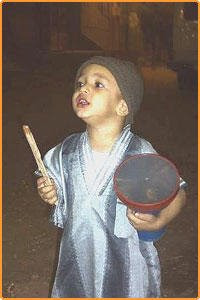 As half the month of Ramadan has passed now, yesterday was the first I've heard of the mesaharaty in years! I admit to having the same nostalgic excitement , to have been up long enough to hear him calling, as i did as a child! The mesaharaty may be extinct in the urban areas, but they are still found in some parts of Cairo and in the villages in the countryside.
 Ramadan is a month that follows the lunar calendar, the basis of the Islamic (or Hijri) calendar. With an eleven-day offset from the Gregorian (western) calendar, astronomical calculations are utilized to detect the birth of the new moon, yet it remains for its visualization after sunset before it is announced on the radio and television. Ramadan lasts for 29 or 30 days, as do most lunar months. ‘Ramadan’ is derived from the word ‘Ramada’ a hot stone, it is meant to burn sins. Fasting became obligatory for Muslims during the second year of the Islamic Calendar, the month in which the Quran was revealed.
 It is astonishing how people feel so happy though they know that they will spend one full month abstaining from food and drink. The period of fasting starts from dawn with the first call of prayer of the day "el fajr" until sunset, when they break their fasting usually with a date, since it is a "sunna" (a habit taken from Prophet Mohammed). Fasting entails abstaining from food, drink, smoking or sinning, no matter how minor. Equally, a fasting Muslim should keep away his/her eyes, tongue and hands from any kind of bad deeds like back biting or else their fasting will be considered incomplete. Children (until a certain age), travelers, the sick, pregnant women and women in their monthly cycle have permission not to fasting. Though the usual daily practice is in most ways normal, Muslims prefer to spend more time praying giving alms and reading the Quran, particularly at night.
 However, it should be noted that officially, monuments and other tourist sites are open until 3:00 pm, while in reality, some of the less frequented sites may close an hour earlier. While there are many restaurants open to tourists, many may not serve alcoholic beverages during Ramadan. However, almost all larger hotels, as well as smaller hotels that cater to tourists will be completely operational, including their bars, and they will serve alcoholic drinks as usual.
  Since Egyptians are big eaters, they usually look forward to Ramadan. "Iftar" is considered the main meal of the day and is often very rich. Any type of food might be served, but traditionally the dessert almost always includes "konafa" or "katayef" as well as a very delicious juice called "kamar el din" (apricot juice). Most people prefer to spend at least the first day in an extended family gathering in the home of the grand parents’. After the first few days, people start to go out after "iftar". And today it has become a tradition for hotels to erect large tents, furnished in the old Arabian decoration, where people enjoy their time listening to old traditional songs and music and smoking "sheesha" or water-pipes, evoking the atmosphere of the old classical days.
 The tradition of hanging lights on mosques and colored flags and the "fanous" (lantern) in alleyways and balconies dates back to a few centuries ago and it was used primarily to light the streets for people who walk at night to the mosques to perform the prayers. The "fanous" is now used by children as a toy that is coupled with this wonderful occasion. Over the years it has evolved in sizes, shapes, colors and may even include musical backgrounds.
 Ramadan culminates in a three day celebration of "Eid al-Fitr". Ramadan ends with the happiness of Eid and the warm heartedness and goodwill the Egyptians feel towards one another. Once the three days of Eid festivities are over they start the count down once again, with love and eagerness, for the coming of the next Ramadan the following year.


