Copyright © Egypt, Cradle of Civilization
Abu Simbel is a massive monument standing proudly since the 13th century B.C. in Upper Egypt, 250 kilometers (or 155.343 miles) southeast of Aswan. The second most popular tourist attraction in Egypt after the pyramids is Abu Simbel. The Abu Simbel Temples are a UNESCO recognized site and part of the larger Nubian Monuments. The Temples are two separate temples next to each other carved in red stone.
 |
Abu Simbel Temples built by Ramesses II in Nubia
|
These gigantic Abu Simbel Temples had to be relocated during the construction of the Aswan High Dam, otherwise they would be buried under the waters of Lake Nasser. The temples now overlook the lake on the western banks and are a must see when visiting Aswan city.
 |
| City of Aswan |
It was built by Rameses II between 1279 and 1213 B.C. to celebrate his domination of Nubia, and his piety to the gods, principally Amun-Ra, Ra-Horakhty and Ptah, as well as his own deification Abu Simbel, much has been said about the purpose of building, like that they were built for Pharaoh Ramesses II and his beloved wife Nefertari.
It was also known as the "Temple of Ramesses, beloved by Amun", one of six rock temples erected in Nubia during the long reign of Rameses. What has been confirmed by most historians is that it is not debatable that a major reason for its building was to impress Egypt's southern neighbors, and to reinforce the status of Egyptian religion in the region.
 |
| Ramesses II of Egypt (c. 1270 BCE) |
The interior of the temple is inside the sandstone cliff in the form of a man-made cave cut out of the rock. It consists of a series of halls and rooms extending back a total of 185 feet from the entrance.
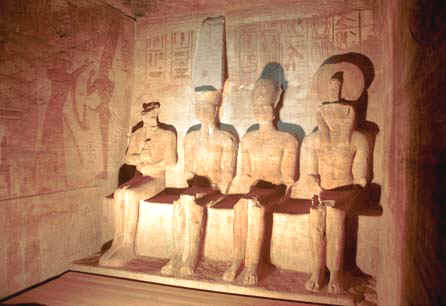 |
| Abu Simbel Temple, Gods' statues |
As you walk to the rear of the temple you come to the Holy of Holies located at the back wall, where you will find four statues of Ra-Harakhte, Ptah, Amun-Ra and King Ramses II.
 |
| Holiest of the Holies from inside Abu Simbel Temple |
The Abu Simbel Festival
The Abu Simbel Temple is second only to the Pyramids in Giza necropolis, and the Abu Simbel Festival is second to none. At sunrise on both days February 21, the king's birthday, and October 22, the date of his coronation, the light creeps into the inner sanctum and shines upon all the statues essentially marking them as god-like. The statue of the god of darkness, Ptah, is appropriately left in the shadows. How this was managed have remained a wonder and a mystery up to now, people in Egypt still celebrate on those dates.

Touring Egypt at this time of the year can make your vacation more special having the privilege of witnessing such a mystical historic biannual event.


 The large sliding window of the cabin room opens directly on to the waters of the river emphasizing the closeness of nature even further. I can never tire of gazing out at the life on the Nile as it drifts by, and the single-sailed feluccas, that remind me of giant butterflies. My personal favorite is the sun-deck, especially during the early hours of the cool morning breeze.


 The Abu Simbel Sun Festival is one of the world's most unique events to date. This week the Solstice occurrence can be witnessed again by crowds that pack into the temple before sunrise. The two dates, February and October the 22nd commemorate King Ramses' ΙΙ ascension to the throne and his birthday respectively.
 It was told that Isis managed to trick the all powerful sun god Ra into telling her his secret name (the name that held all his divine power). By creating a magical serpent that bit Ra. She was called upon to cure him but to do so she had to know his secret name, which he finally divulged giving her power equal to his own and so she became divine and as powerful as Ra himself.
 The end to this religion came in 535 A.D. when the Roman emperor Flavius Anicius Justinianus ordered the closure of the temple, forbad the art of reading and writing hieroglyphs and imprisoned its priests. This put an end to the religion that had spread beyond the lands of Egypt and spread all across the Mediterranean.
 Isis was the sister-wife of Osiris and the mother of the god Horus. Osiris was a great and just king who was loved by his people and wife, but he was hated by his brother Seth (the god of the underworld). Seth was jealous of his brother so he devised a plan to get rid of him. He secretly obtained Osiris' measurements and had a magnificent casket of the rarest wood and decorated with ebony, ivory, silver and gold made to fit him exactly. He then held a great feast in honor of Osiris where he offered to give the casket to whoever fit it exactly. With the aid of 72 of his wicked friends they tricked Osiris into trying it for size, but as soon as he lay in it they nailed the lid shut and threw the casket into the Nile.
 And when no one was looking she opened the chest and turned into a bird called the kite and flapped her mighty wings. The wind created by her wings gave Osiris the Breath of Life for one day, during which she conceived her son Horus from him. Seth managed to find the casket again and after opening it he rented the body into 14 pieces and scattered them along the shores of the Nile for the crocodiles to eat. Isis seeking the help of her sister Nephthys and Anubus the son of Nephthys, who was said to take the form of a jackal to find all the pieces of Osiris. All the pieces were recovered except for one. She stuck the pieces together and wrapped him in linen making him the first Egyptian mummy. Not able to return in a human form, Osiris was sent to rule the underworld, being the only person to live after death.
  Isis then returned to raise her son Horus, who often took the form of a hawk. Horus eventually avenges the death of his father and manages to defeat Seth. Horus was then given the privilege of taking his father's place and ruling Earth as Osiris had once done.


 About the Author: