Following up on our story telling, I came across the tale of "Rhodopis" (the rosy-cheeked), which resembled the story line of "Cinderella" with a few variations here and there, the most significant being the glass slipper, which in the still romantic ancient Egyptian version is a "rose red-gilded slipper." This version is the oldest dating back to 570-526 B.C. which makes it older than the Chinese "Yeh-Shen" which was first recorded in a book called The Miscellaneous Record of Yu Yang from the T'ang dynasty of 618-907 A.D.
The story is told in the time just before the country was invaded by the Persians. The ruling Pharaoh at the time was Ahmose Ι and to strengthen his country against this inevitable invasion he invited as many Greeks to trade and settle in Egypt. He even gave them a city of their own, the city of Naucratis.

Naucratis was at the mouth of the Nile that led to the sea, and was one of the richest cities at the time. One of Naucratis' richest merchants was Charaxos. He was originally from the Greek island of Lesbos, and the brother of the famous poetess Sappho. And as he had spent many years trading with Egypt he settled in Naucratis in his old age. One day as he passed through the market place be noticed a crowd, curious he pushed his way through to find a beautiful slave girl, who had just been set up on the stone rostrum to be sold. Her beauty caught his breath for she was fair skinned and with rosy red cheeks and being wealthy it was easy for Charaxos to buy her.

Rhodopis had been kidnapped by pirates as a child from her home in the north of Greece and sold into slavery. Her rich employer had many slaves, and one of her fellow slaves was a little old man called Aesop, who was kind and told her stories and fables about birds, animals and humans. But her master wished to make more money so he sent her to the rich Naucratis to be sold.
 As she was different from the other house-girl servants, with pale skin, rosy cheeks, golden hair that blew in the wind and bright green eyes, they were very jealous of her, teasing and making fun of her. They gave her all the dirty chores of washing cloths and weeding the garden. Her master was old and spent most of his day sleeping under a fig tree, but one day he woke to see Rhodopis dancing with such beautiful grace, he presented her with a pair of red-rose gilded slippers, which caused even more jealousy from the other servant girls.
One day the Pharaoh was holding court, to which everyone in the land was invited, but the servant girls made sure that Rhodopis had chores that she would not finish in time to attend the celebration. And as she sang to her friend the hippopotamus while she did the washing by the edge of the river, he splashed water on her rose red slippers. Rhodopis cleaned them and put them behind her as she went on with her chores. The god Horus came down from the sky as a falcon and took a slipper in his talons. He soared with his great wings, still carrying the slippers, south over the valley of the Nile until be came to Memphis, and swooped down towards the palace of the Pharaoh. He dropped the slipper in the Pharaoh's lap, since it was bright he thought it was a scrap of the Sun, and then he realized it was a gift from the gods.
 He was so moved by what happened that he decreed that, all the land be searched for who ever fits the slipper, and the owner will be Pharaoh's wife. Ahmose’s search eventually leads him to Rhodopis’ home. Though Rhodopis hides when she sees the Pharaoh’s barge, he sees her and asks her to try the slipper. After demonstrating that it fits her, she pulls out its mate, and the Pharaoh declares that she will be his Queen and the Royal Lady of Egypt, and they live happily ever after of course!


 It was told that Isis managed to trick the all powerful sun god Ra into telling her his secret name (the name that held all his divine power). By creating a magical serpent that bit Ra. She was called upon to cure him but to do so she had to know his secret name, which he finally divulged giving her power equal to his own and so she became divine and as powerful as Ra himself.
 The end to this religion came in 535 A.D. when the Roman emperor Flavius Anicius Justinianus ordered the closure of the temple, forbad the art of reading and writing hieroglyphs and imprisoned its priests. This put an end to the religion that had spread beyond the lands of Egypt and spread all across the Mediterranean.
 Isis was the sister-wife of Osiris and the mother of the god Horus. Osiris was a great and just king who was loved by his people and wife, but he was hated by his brother Seth (the god of the underworld). Seth was jealous of his brother so he devised a plan to get rid of him. He secretly obtained Osiris' measurements and had a magnificent casket of the rarest wood and decorated with ebony, ivory, silver and gold made to fit him exactly. He then held a great feast in honor of Osiris where he offered to give the casket to whoever fit it exactly. With the aid of 72 of his wicked friends they tricked Osiris into trying it for size, but as soon as he lay in it they nailed the lid shut and threw the casket into the Nile.
 And when no one was looking she opened the chest and turned into a bird called the kite and flapped her mighty wings. The wind created by her wings gave Osiris the Breath of Life for one day, during which she conceived her son Horus from him. Seth managed to find the casket again and after opening it he rented the body into 14 pieces and scattered them along the shores of the Nile for the crocodiles to eat. Isis seeking the help of her sister Nephthys and Anubus the son of Nephthys, who was said to take the form of a jackal to find all the pieces of Osiris. All the pieces were recovered except for one. She stuck the pieces together and wrapped him in linen making him the first Egyptian mummy. Not able to return in a human form, Osiris was sent to rule the underworld, being the only person to live after death.
  Isis then returned to raise her son Horus, who often took the form of a hawk. Horus eventually avenges the death of his father and manages to defeat Seth. Horus was then given the privilege of taking his father's place and ruling Earth as Osiris had once done.
 The Egyptians were one of the earliest civilizations to kept record in writing their everyday lives. However, the earliest preserved story written dates back from the Middle Kingdom, and because most of their literary tradition was oral or spoken, it was never written down, so the works that have actually survived are fewer than be expected.
 From autobiographies and mythological tales to folk and fairy tales the ancient Egyptians made journals of it all, on papyrus paper, walls or even slabs of stone. My personal favorite is the Legend of Isis and Osiris. The story tells of the good and benevolent King Osiris
 There's also the oldest Cinderella story, but in the ancient Egyptian version the glass slippers are "rose red slippers". And from the Ptolemaic period there's "The Seven Years of Famine" which was discovered on the rocks of the Island of Sahal in 1890 by Charles Wilbour. But the oldest and most popular tales of Egyptians was the story of Sinuhe. This story was preserved in six papyri and two dozen ostraca. This biography tells of Sinuhe who fled Egypt to Western Asia after the assassination of King Amenemhat Ι. After many years Sinuhe returned to his homeland when he was pardoned by King Senusert Ι and reinstated at the royal court.
  The fairy tale of Setne Khamwas, a son of Ramesses ΙΙ tells of his fascination with the magic texts of the past brought him to an encounter with the ghost of a long dead magician in his tomb at Saqqara. In a story within a story, he learned of an episode of the magician's life. On the golden shrine of Tutankhamun, was the story "The Book of the Cow of Heaven" (or "the Destruction of Mankind") which tells of the sun god, Ra, who was confronted with a rebellion of mankind, so he sent his "eye," Hathor, or in a later version, Sekhmet, down to earth in the form of a lioness, which proceeded to devour men. When Ra called her back she refused, so he had to trick her. One night he created a red colored beer that looked like human blood. Sekhmet drank it all and became intoxicated and so in this way Ra saved humankind.
  "The Turquoise Amulet" was a story of a maiden who loses a hair clasp in the form of an amulet of turquoise. This is one of the stories that helped to give Snefru the title of The Good King, for it shows his good nature and his willingness to please others, something other pharaohs would not dream of doing. Another story that was written on the Harris Papyrus which is housed in the British Museum is "The Doomed Prince". When it was first discovered the story was complete, but since then, the papyrus has been partly destroyed and the end of the story has been lost. This story may also be known by the title "The Crocodile, the Snake and the Dog" because it tells of a prince who was fated by the gods to die by the Snake, the Crocodile or the Dog.
  The tales are many, and are all fascinating and captivating. During the course of the next few posts we'll rediscover their charm, also getting an insight into a culture that built its civilization on stories of the gods.
 Ramadan being a time of spiritual rituals, charity and tradition, I always loved the nostalgic feel the month brings along every year. And as a child at this time of year my fixations were the colourful fanous (lantern) and to stay up long enough to hear the mesaharaty passing through the streets calling for people to wake up.
  The mesaharaty walks through the neighborhood shortly before dawn, calling on to people to wake up to take el Sohour (the last meal before they begin the fasting of the new day). Traditionally he would walk through the streets and alleys beating a small drum to a simple rhythm and calling people by their names to wake up!
 The mesaharaty tradition goes back to the early days of Islam. Bilal Ibn Maktoom was the first mesaharaty in Islam and he used to call people from the top of the mosque to stop eating. The tradition started in Egypt in the year 238 AH (Hijri) with Antaba Bin Ishaq, the ruler of Egypt, himself walking from Fustat City (old Cairo) to Amr Ibn Al-Aas Mosque singing " e'bad Allah tasaharo " (worshipers of Allah, eat Sohour). In time, the drum was introduced as an instrument to assist the mesaharaty.
 During Ramadan people usually stay up late, accommodating the mesaharaty perfectly because he makes so much noise in the early hours that he can be heard for several blocks in all directions. He does not get a fixed salary but depends on receiving donations from the neighborhood at the end of Ramadan, when the people whose names have been called donate money. Though the mesaharaty may not know all his neighbors by name as he did in the past, many continue the tradition of drumming and chanting for people to wake up to eat. Although the alms he gets may not be much to put bread on the table, the expression of excitement lighting up a child's face is sometimes satisfaction enough. In the old days, the mesaharaty was accompanied by the children of the neighborhood who helped him beat his drum and call for sohour.
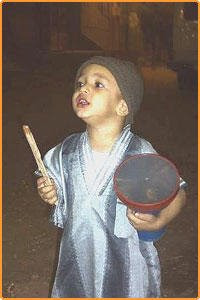 As half the month of Ramadan has passed now, yesterday was the first I've heard of the mesaharaty in years! I admit to having the same nostalgic excitement , to have been up long enough to hear him calling, as i did as a child! The mesaharaty may be extinct in the urban areas, but they are still found in some parts of Cairo and in the villages in the countryside.
 Ramadan is a month that follows the lunar calendar, the basis of the Islamic (or Hijri) calendar. With an eleven-day offset from the Gregorian (western) calendar, astronomical calculations are utilized to detect the birth of the new moon, yet it remains for its visualization after sunset before it is announced on the radio and television. Ramadan lasts for 29 or 30 days, as do most lunar months. ‘Ramadan’ is derived from the word ‘Ramada’ a hot stone, it is meant to burn sins. Fasting became obligatory for Muslims during the second year of the Islamic Calendar, the month in which the Quran was revealed.
 It is astonishing how people feel so happy though they know that they will spend one full month abstaining from food and drink. The period of fasting starts from dawn with the first call of prayer of the day "el fajr" until sunset, when they break their fasting usually with a date, since it is a "sunna" (a habit taken from Prophet Mohammed). Fasting entails abstaining from food, drink, smoking or sinning, no matter how minor. Equally, a fasting Muslim should keep away his/her eyes, tongue and hands from any kind of bad deeds like back biting or else their fasting will be considered incomplete. Children (until a certain age), travelers, the sick, pregnant women and women in their monthly cycle have permission not to fasting. Though the usual daily practice is in most ways normal, Muslims prefer to spend more time praying giving alms and reading the Quran, particularly at night.
 However, it should be noted that officially, monuments and other tourist sites are open until 3:00 pm, while in reality, some of the less frequented sites may close an hour earlier. While there are many restaurants open to tourists, many may not serve alcoholic beverages during Ramadan. However, almost all larger hotels, as well as smaller hotels that cater to tourists will be completely operational, including their bars, and they will serve alcoholic drinks as usual.
  Since Egyptians are big eaters, they usually look forward to Ramadan. "Iftar" is considered the main meal of the day and is often very rich. Any type of food might be served, but traditionally the dessert almost always includes "konafa" or "katayef" as well as a very delicious juice called "kamar el din" (apricot juice). Most people prefer to spend at least the first day in an extended family gathering in the home of the grand parents’. After the first few days, people start to go out after "iftar". And today it has become a tradition for hotels to erect large tents, furnished in the old Arabian decoration, where people enjoy their time listening to old traditional songs and music and smoking "sheesha" or water-pipes, evoking the atmosphere of the old classical days.
 The tradition of hanging lights on mosques and colored flags and the "fanous" (lantern) in alleyways and balconies dates back to a few centuries ago and it was used primarily to light the streets for people who walk at night to the mosques to perform the prayers. The "fanous" is now used by children as a toy that is coupled with this wonderful occasion. Over the years it has evolved in sizes, shapes, colors and may even include musical backgrounds.
 Ramadan culminates in a three day celebration of "Eid al-Fitr". Ramadan ends with the happiness of Eid and the warm heartedness and goodwill the Egyptians feel towards one another. Once the three days of Eid festivities are over they start the count down once again, with love and eagerness, for the coming of the next Ramadan the following year.