Copyright © EgyptHasItAll.com
During the month of
Ramadan the whole country acquires a festive feel. Muslims in
Egypt always celebrated the coming of the holy month of
Ramadan with lights and decorations. So traveling to
Egypt during
Ramadan is a truly unique and animated experience which will further add to your experience and your cultural knowledge of the country. It is the most important festival in the Islamic calendar, with Muslims celebrating the month with joy & happiness. They prepare for it by hanging up colored decorations in the streets and banners announcing that
Ramadan is coming soon. During
Ramadan, people greet each other with the words
"Ramadan Karim." Ramadan is a month that follows the lunar calendar, the basis of the Islamic (or Hijri) calendar. With an eleven-day offset from the Gregorian (western) calendar, astronomical calculations are utilized to detect the birth of the new moon, yet it remains for its visualization after sunset before it is announced on the radio and television. Ramadan lasts for 29 or 30 days, as do most lunar months. ‘Ramadan’ is derived from the word ‘Ramada’ a hot stone, it is meant to burn sins. Fasting became obligatory for Muslims during the second year of the Islamic Calendar, the month in which the Quran was revealed.
Ramadan is the month during which Prophet Mohammed received the revelation of the Quran fourteen centuries ago. According to Islam, the month is dedicated to prayers, as it is believed that it is an occasion to wash one’s sins away and enjoy God’s unlimited mercy. Ramadan in Egypt is special with many activities that show the true nature of Egyptians. In essence they are religious, enjoy charity and social gatherings.
 It is astonishing how people feel so happy though they know that they will spend one full month abstaining from food and drink. The period of fasting starts from dawn with the first call of prayer of the day "el fajr" until sunset, when they break their fasting usually with a date, since it is a "sunna" (a habit taken from Prophet Mohammed). Fasting entails abstaining from food, drink, smoking or sinning, no matter how minor. Equally, a fasting Muslim should keep away his/her eyes, tongue and hands from any kind of bad deeds like back biting or else their fasting will be considered incomplete. Children (until a certain age), travelers, the sick, pregnant women and women in their monthly cycle have permission not to fasting. Though the usual daily practice is in most ways normal, Muslims prefer to spend more time praying giving alms and reading the Quran, particularly at night.
 However, it should be noted that officially, monuments and other tourist sites are open until 3:00 pm, while in reality, some of the less frequented sites may close an hour earlier. While there are many restaurants open to tourists, many may not serve alcoholic beverages during Ramadan. However, almost all larger hotels, as well as smaller hotels that cater to tourists will be completely operational, including their bars, and they will serve alcoholic drinks as usual.

Since Egyptians are big eaters, they usually look forward to
Ramadan.
"Iftar" is considered the main meal of the day and is often very rich. Any type of food might be served, but traditionally the dessert almost always includes
"konafa" or
"katayef" as well as a very delicious juice called
"kamar el din" (apricot juice). Most people prefer to spend at least the first day in an extended family gathering in the home of the grand parents’. After the first few days, people start to go out after
"iftar". And today it has become a tradition for hotels to erect large tents, furnished in the old Arabian decoration, where people enjoy their time listening to old traditional songs and music and smoking
"sheesha" or water-pipes, evoking the atmosphere of the old classical days.

The tradition of hanging lights on mosques and colored flags and the
"fanous" (lantern) in alleyways and balconies dates back to a few centuries ago and it was used primarily to light the streets for people who walk at night to the mosques to perform the prayers. The
"fanous" is now used by children as a toy that is coupled with this wonderful occasion. Over the years it has evolved in sizes, shapes, colors and may even include musical backgrounds.

The story of
"the Canon of Ramadan" dates back to the time of the
Viceroy of Cairo, who received the gun as a present. He ordered his assistants to try it. The experiment took place about sunset during the first day of
Ramadan. The people took it as a sign to announce the end of the day's fast. Since then the Viceroy ordered that the gun should be fired at sunset and this became a constant feature of
Ramadan. The gun is still fired today although it has now been replaced by the radio and TV.
Regardless of religion, it is a common thing to find many Muslims and Christians gathered together at the time of
"iftar". It is not considered good manners to outwardly make a display of not fasting. Though not illegal, those who do not fast would usually hide to eat drink or smoke. Egyptian Christians also participate in most of these practices with their fellow Muslims. Some would also fast as a sign of national unity, but even those who do not would never eat or drink in public, as a sign of respect to Islamic traditions.
 Ramadan
 culminates in a three day celebration of
"Eid al-Fitr". Ramadan ends with the happiness of
Eid and the warm heartedness and goodwill the Egyptians feel towards one another. Once the three days of
Eid festivities are over they start the count down once again, with love and eagerness, for the coming of the next
Ramadan the following year.
About the Author:
-----------------------------------------------------------------
 Ramadan being a time of spiritual rituals, charity and tradition, I always loved the nostalgic feel the month brings along every year. And as a child at this time of year my fixations were the colourful fanous (lantern) and to stay up long enough to hear the mesaharaty passing through the streets calling for people to wake up.
  The mesaharaty walks through the neighborhood shortly before dawn, calling on to people to wake up to take el Sohour (the last meal before they begin the fasting of the new day). Traditionally he would walk through the streets and alleys beating a small drum to a simple rhythm and calling people by their names to wake up!
 The mesaharaty tradition goes back to the early days of Islam. Bilal Ibn Maktoom was the first mesaharaty in Islam and he used to call people from the top of the mosque to stop eating. The tradition started in Egypt in the year 238 AH (Hijri) with Antaba Bin Ishaq, the ruler of Egypt, himself walking from Fustat City (old Cairo) to Amr Ibn Al-Aas Mosque singing " e'bad Allah tasaharo " (worshipers of Allah, eat Sohour). In time, the drum was introduced as an instrument to assist the mesaharaty.
 During Ramadan people usually stay up late, accommodating the mesaharaty perfectly because he makes so much noise in the early hours that he can be heard for several blocks in all directions. He does not get a fixed salary but depends on receiving donations from the neighborhood at the end of Ramadan, when the people whose names have been called donate money. Though the mesaharaty may not know all his neighbors by name as he did in the past, many continue the tradition of drumming and chanting for people to wake up to eat. Although the alms he gets may not be much to put bread on the table, the expression of excitement lighting up a child's face is sometimes satisfaction enough. In the old days, the mesaharaty was accompanied by the children of the neighborhood who helped him beat his drum and call for sohour.
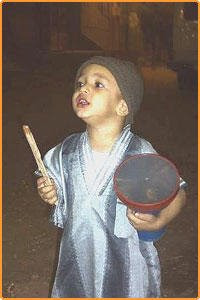 As half the month of Ramadan has passed now, yesterday was the first I've heard of the mesaharaty in years! I admit to having the same nostalgic excitement , to have been up long enough to hear him calling, as i did as a child! The mesaharaty may be extinct in the urban areas, but they are still found in some parts of Cairo and in the villages in the countryside.
